
Showdown Synchronized Planning
Base
Desperados 3
- Status
- Released
- Year
- 2020
- Genre
- Strategy
- Platforms
- Windows, macOS, Linux
1. Summary
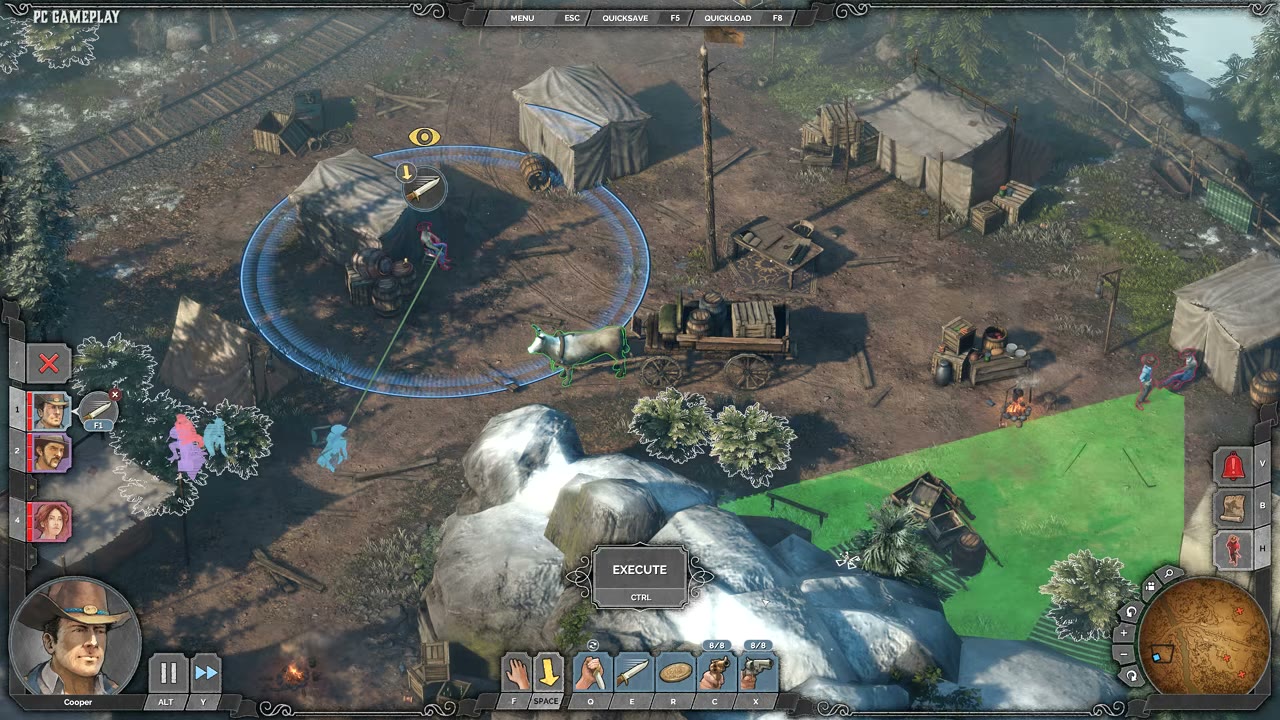
Showdown Mode lets the player pause real-time action, assign queued commands to squad members, and execute them together or separately. This turns timing-heavy stealth encounters into planned synchronized sequences, enabling coordinated kills, body handling, and multi-angle area clears while preserving the need to rehearse because guard coverage and alarms still punish bad plans.
3. Design Intent / Job Story
When I am facing a patrol pattern or guarded outpost that is too timing-sensitive to solve comfortably in real time, I want to pause into Showdown Mode, queue each squad member's movement and action, and choose the right execution moment, so that a coordinated plan can neutralize threats without raising the alarm.
4. Role in Gameplay Loop
- Converts reflex-heavy stealth timing into a readable planning-and-execution step.
- Lets the player coordinate multiple characters whose abilities, ranges, movement speeds, and positions differ.
- Creates the main bridge between observation tools, ability selection, and synchronized takedowns.
- Supports offensive ambushes against watched targets while preserving stealth consequences if timing, visibility, or noise are wrong.
- Reinforces the trial-and-error loop by letting players rehearse a plan, watch why it fails, reload, and refine the sequence.
5. Preconditions
- An active mission encounter is running.
- At least one controllable squad member is available.
- Showdown Mode has been unlocked and is not blocked by a modal, cutscene, failure state, or loading transition.
- The selected character has at least one valid movement command, ability, attack, interaction, or targetable action.
- The player can read enough enemy patrol, vision, sound, or route information to judge whether the queued plan is safe.
- For synchronized outcomes, multiple queued actions must remain valid until execution starts.
6. Parameters
| Parameter | Value | Type | Notes |
|---|---|---|---|
| Planning Time Mode | Freeze / pause planning | enum | Encounter state used while the player queues Showdown commands. |
| Queue Scope | Per controllable character | state set | Characters can hold their own planned movement and/or action. |
| Global Execute Command | Execute | input/action | Commits eligible queued actions as a synchronized plan. |
| Per-Character Execute Command | Character-specific activation input | input/action | Fires an individual character's queued command for staggered timing. |
| Continue Command | Continue | input/action | Leaves or resumes from planning without globally committing queued actions. |
| Queued Command Types | Movement, attack, ability, interaction, body-related action | enum set | Types of actions that can participate in a Showdown plan when valid. |
| Target Validity | Range, line of sight, ability rules, target state | rule set | Conditions a queued command must satisfy before it can execute correctly. |
| Execution Timing | Immediate on command, then real-time resolution | duration | Queued actions begin when triggered but still play out with normal movement and action timings. |
| Stagger Offset | Variable | player-controlled timing | Delay between manually triggering different characters' queued actions. |
| Movement Posture | Crouched / standing / sprinting where supported | enum | Affects how quickly queued movement reaches targets and whether a plan beats detection timing. |
| Detection Consequence | Suspicion, alarm, reinforcements, mission failure risk | enum set | Possible outcomes if execution is seen, heard, or leaves bodies exposed. |
| UI Feedback | Execute/Continue prompt, queued markers, targeting lines, cones | HUD/spatial markers | Feedback that exposes the queued plan and tactical risk before execution. |
7. Core Rules
- Entering Showdown Mode pauses or freezes the real-time encounter into a planning state where the player can issue queued commands.
- Each controllable character can be assigned a planned movement and/or action according to that character's available abilities and current tactical state.
- Queued commands can be committed together through the main Execute command when the player wants a synchronized resolution.
- Queued commands can also be launched per character through the character's corresponding activation input, allowing staggered timing instead of a single global execution.
- A queued action may be prepared before the target is immediately exposed, then executed when line of sight, patrol position, or timing becomes favorable.
- Showdown Mode does not make actions inherently safe; enemy vision, watched targets, body discovery, noise radius, movement speed, and alarm escalation still resolve normally once execution begins.
- Characters keep their normal action constraints during planning, including range, line of sight, ammo or item count, target validity, movement posture, and enemy-type restrictions.
- If a plan requires one character to move farther than another, the player may need staggered activation so arrival and impact happen at the intended time.
- Crouched or slow movement can cause queued takedowns to arrive too late; standing or sprinting before execution may be necessary for fast ambush timing.
- Queued markers, targeting lines, cones, prompts, and HUD commands must update when the player changes, cancels, or executes the plan.
- Executing a bad plan can still produce detection, alarms, reinforcements, death, resource loss, or a need to reload and revise the setup.
8. BDD Scenarios
Scenario: Queue and execute a synchronized takedown
- Given
- Showdown Mode is active during a live stealth encounter
- When
- the player presses Execute
- Then
- the queued actions begin resolving in real time
- And
- two squad members each have a valid queued takedown against separate watched enemies
- And
- the enemies are neutralized without an alarm if both takedowns complete before either enemy can alert others
Scenario: Hold a queued ranged action for the right moment
- Given
- Showdown Mode is active
- When
- the target moves into a favorable line of sight or timing window
- Then
- the player can execute the queued action at that moment
- And
- a ranged attack has been queued against a target that is not currently safe to shoot
- And
- the attack resolves using the normal range, visibility, noise, and alarm rules
Scenario: Stagger character activations
- Given
- two queued actions require different travel or wind-up times
- When
- the player triggers one character's queued action before triggering the other character's queued action
- Then
- the actions can land closer to the intended synchronized timing
- And
- executing both at once would allow one enemy to react before the other is neutralized
- And
- the alarm is avoided if the timing beats enemy reaction windows
Scenario: Continue without committing the plan
- Given
- Showdown Mode is active
- When
- the player chooses Continue instead of Execute
- Then
- the game leaves or resumes from the planning state without firing the entire queued plan
- And
- the player has visible queued-action markers or targeting lines
- And
- the player can reposition, revise, or cancel the setup
Scenario: Bad posture causes a failed ambush
- Given
- a queued melee takedown requires fast movement to reach the target before detection escalates
- When
- the queued action starts
- Then
- the slower movement can cause late arrival
- And
- the acting character begins execution while crouched
- And
- nearby guards may detect the action or raise an alarm before the takedown completes
9. Edge Cases
- Execute is pressed with no valid queued actions.
- A queued target moves, dies, becomes hidden, leaves range, or is no longer targetable before execution.
- A queued path becomes blocked by terrain, doors, crowds, enemies, bodies, or another squad member.
- One character is incapacitated, controlled, interrupted, or otherwise unavailable before their queued action fires.
- Two or more queued actions overlap on the same target, causing redundant attacks, wasted resources, or confusing marker stacking.
- A staggered activation is mistimed so the first takedown is observed before the second lands.
- A queued action is legal in planning but becomes unsafe because a patrol changes facing or a watcher enters line of sight.
- Movement posture changes action timing; crouched movement may be stealthier but too slow for a quick ambush.
- Queued firearm or explosive actions resolve correctly but create enough noise to alert guards outside the visual focus.
- Continue or cancel must not accidentally consume ammo, trigger abilities, move characters, or leave stale queued markers.
- Quickload after a failed execution must restore queued-plan, HUD, cooldown, detection, body, alarm, and character states from the saved point without leftovers from the discarded attempt.
10. QA Notes
- Verify Showdown Mode freezes or pauses the encounter for planning and resumes real-time resolution on execution.
- Verify one character can queue movement plus action, and multiple characters can each hold separate queued commands.
- Verify Execute triggers all eligible queued actions together according to the synchronized execution rules.
- Verify per-character activation supports staggered timing and does not force a global execute.
- Verify Continue exits or resumes without firing the queued plan.
- Verify queued markers, targeting lines, button prompts, and character HUD state appear, update, and clear correctly.
- Verify invalid targets, blocked paths, range failures, line-of-sight failures, and unavailable abilities are communicated before or during execution without corrupting the queue.
- Verify enemy perception, alarm escalation, body discovery, and noise reactions still occur normally during and after queued execution.
- Verify movement posture affects arrival timing consistently, including crouched versus standing/sprinting ambush attempts.
- Verify quicksave and quickload around Showdown planning and execution restore the correct tactical state.
11. Mechanic Dependencies
- Trial-and-Error Save Iteration Loop (Showdown plans are commonly rehearsed through quicksave, failed execution, quickload, and timing refinement in dense stealth encounters.)
- Squad Character Ability System (Showdown queues and executes the selected squad members' character-specific movement, weapons, tools, and abilities, so it depends on the ability system for valid commands and role differences.)
- Takedown and Body Control (Many Showdown plans center on synchronized kills, knockouts, body carrying, or concealment, so body-control outcomes determine whether the plan stays stealthy after execution.)
- Enemy Perception and Alarm AI (The success or failure of a Showdown plan is resolved through enemy vision, watched targets, patrol awareness, body discovery, and alarm escalation.)
- Lethal and Non-Lethal Combat Resource Limits (Queued attacks still consume combat resources and obey range, noise, ammo, cooldown, and enemy-type constraints during execution.)
- Movement, Terrain, and Cover Navigation (Queued movement timing depends on terrain, pathing, crouch/standing posture, and route availability, especially when staggered activations must land together.)
12. UI Links
- Character Action Bar - The Character Action Bar provides the selected character's abilities, hotkeys, counters, and action selection entry point for queuing Showdown commands.
- Showdown Mode Execution Interface - The Showdown Mode Execution Interface exposes the core Continue/Execute controls, queued-action markers, and targeting lines used to review and commit synchronized plans.
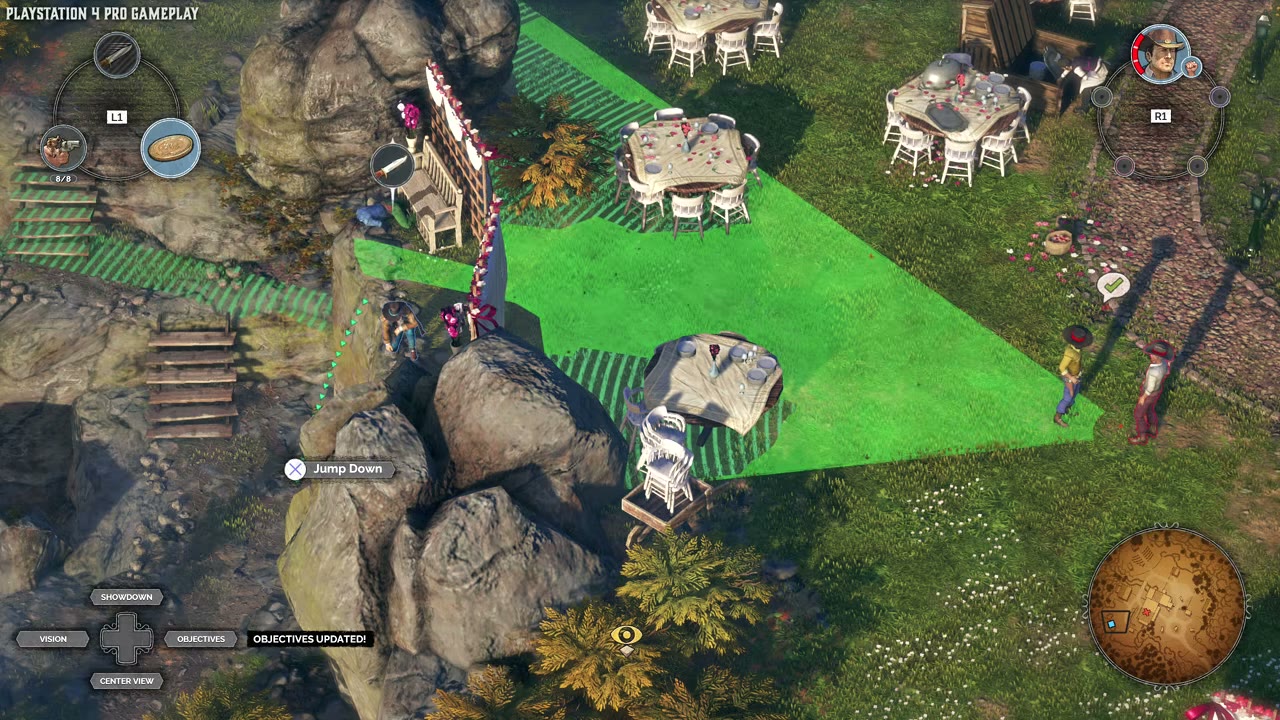
- Tactical Spatial Markers - Tactical Spatial Markers show view cones, prompts, targeting overlays, and Showdown/path markers that let the player judge whether a queued plan is safe before execution.
References
- 1.
DESPERADOS III - Know THESE Important Tips Before Playing (1:10-3:10)
- 2.
DESPERADOS III - Know THESE Important Tips Before Playing (4:43-4:53)
- 3.
DESPERADOS III - Know THESE Important Tips Before Playing (7:06-7:47)
- 4.
Desperados 3 Review (3:06-3:52)
- 5.
Desperados III (L250-270 of 283)