
Squad Character Ability System
Base
Desperados 3
- Status
- Released
- Year
- 2020
- Genre
- Strategy
- Platforms
- Windows, macOS, Linux
1. Summary
The player controls a squad of five playable outlaws, each with distinct movement traits, weapons, tools, takedown speeds, body-handling limits, and utility roles. Missions are solved by combining complementary kits such as distractions, long-range shots, traps, disguises, healing, mind control, and mobility access rather than by treating characters as interchangeable units.
3. Design Intent / Job Story
When a mission presents overlapping patrols, sightlines, and objective constraints, I want to swap between squad members with distinct abilities and combine their tools, so that I can create a safe tactical solution that no single character could perform alone.
4. Role in Gameplay Loop
- Defines the squad as specialized tactical roles rather than interchangeable units.
- Creates the problem-solving vocabulary for stealth, combat, distraction, infiltration, traversal, healing, and body control.
- Forces the player to read each encounter and select the character/tool whose constraints fit the space, enemy type, and timing window.
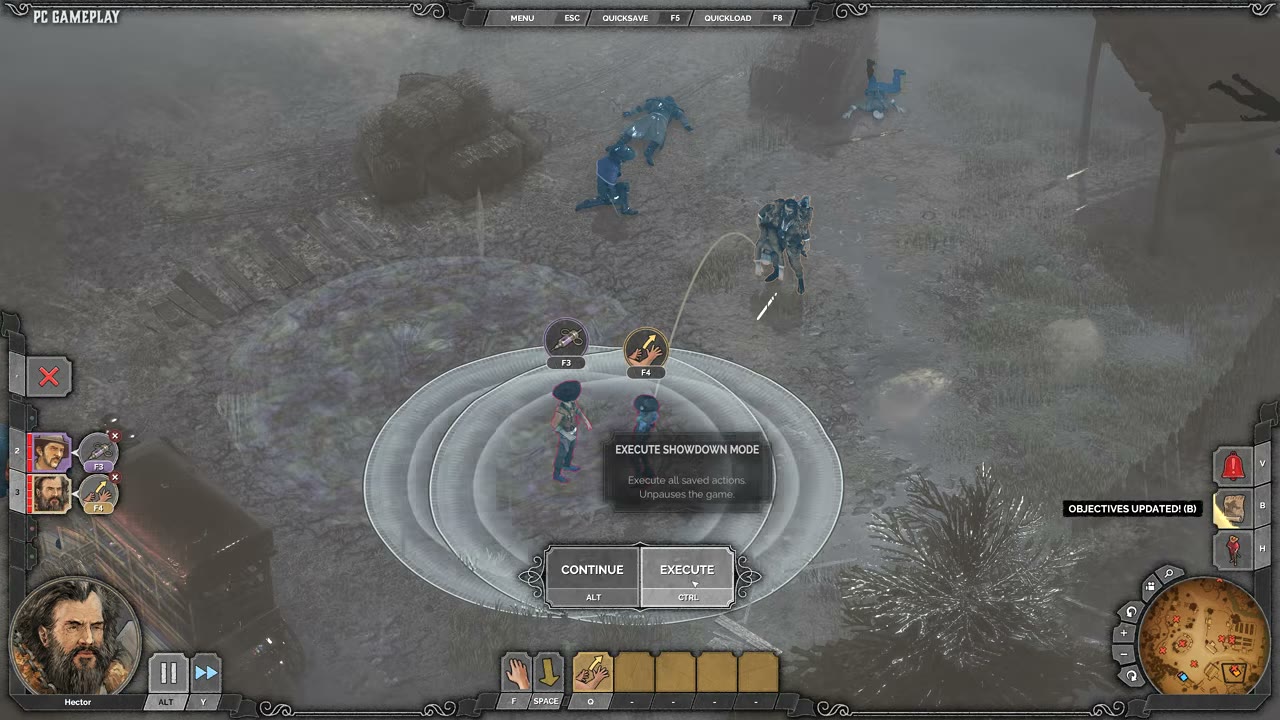
- Feeds Showdown planning by giving each selected character different actions to queue and synchronize.
- Supports replayability because the same mission space can be approached with different ability combinations and risk profiles.
5. Preconditions
- A gameplay mission is active.
- At least one playable squad member is available and controllable.
- The selected squad member is alive, conscious, and not locked out by mission scripting.
- The selected ability is unlocked for that character in the current mission.
- The target, destination, or world object satisfies the selected ability's range, line-of-sight, resource, and enemy-type requirements.
6. Parameters
| Parameter | Value | Type | Notes |
|---|---|---|---|
| Squad size | Up to 5 playable characters | integer | Maximum cast represented by the system across the campaign; mission party composition may be smaller. |
| Active character | One available squad member | enum/ref | Character whose portrait, action bar, targeting rules, and command context are currently active. |
| Ability loadout | Character-specific | set | Actions, tools, weapons, and special interactions available to the selected character in the current mission. |
| Ability slot hotkey | Per controls configuration | input binding | Key or button label displayed under each action bar slot. |
| Ability resource counter | 0..capacity / TBD by ability | integer | Remaining ammunition, charges, or uses for limited abilities. |
| Noise radius | Ability-specific | distance | Area in which enemies can hear the selected action; loud firearms have larger risk radii than quiet tools. |
| Effective range | Ability-specific | distance | Maximum distance from character to target or placement location. |
| Target validity | Ability-specific | ruleset | Enemy type, line of sight, status, terrain, and interaction requirements needed before execution or queuing. |
| Body capacity | Character-specific | integer | Number/type of bodies the character can carry, drag, tie, move, or otherwise manipulate. |
| Takedown profile | lethal / non-lethal / none / special | enum | Defines whether the character can kill, knock out, tie, or only assist via setup tools. |
| Mobility profile | character-specific | enum | Movement strengths and limits such as speed, climbing/swimming access, crouch behavior, and traversal options. |
| Showdown queue eligibility | Ability-specific | boolean | Whether the action can be assigned as a planned Showdown command before execution. |
7. Core Rules
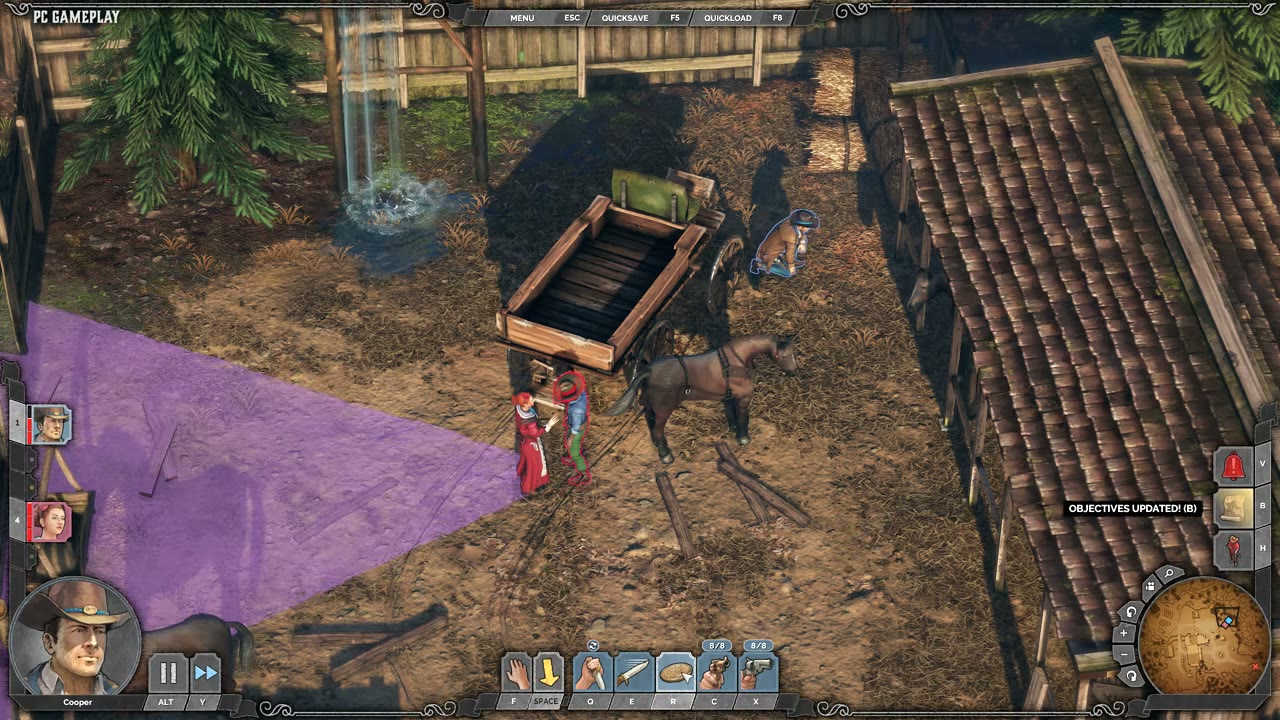
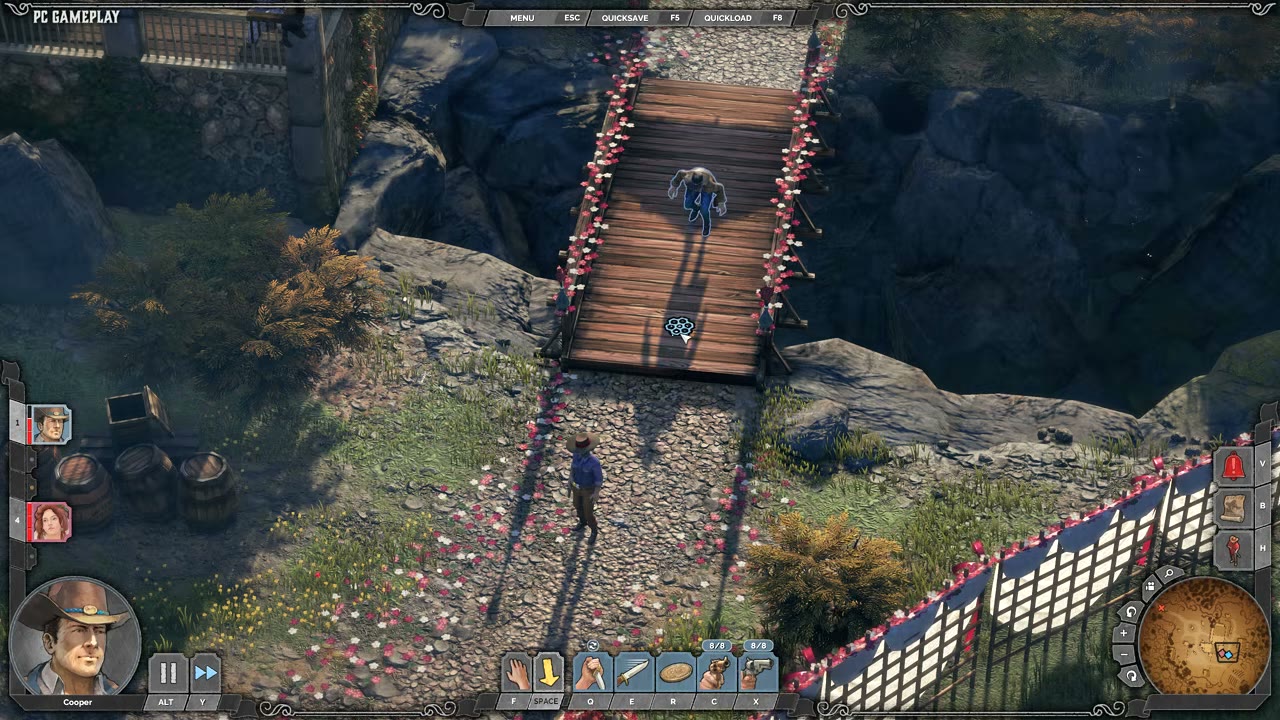
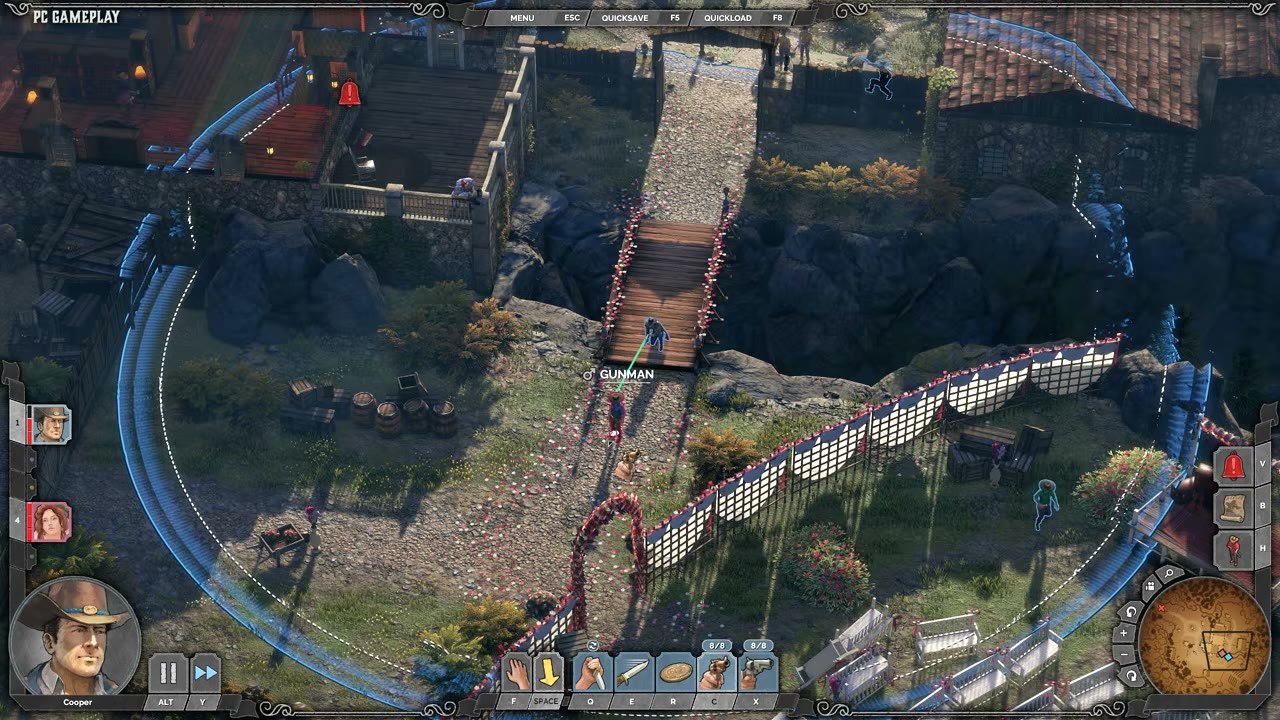
- Each playable squad member owns a distinct ability loadout exposed through the selected-character action bar.
- Changing the selected character changes the available action icons, hotkeys, resource counters, and valid target set.
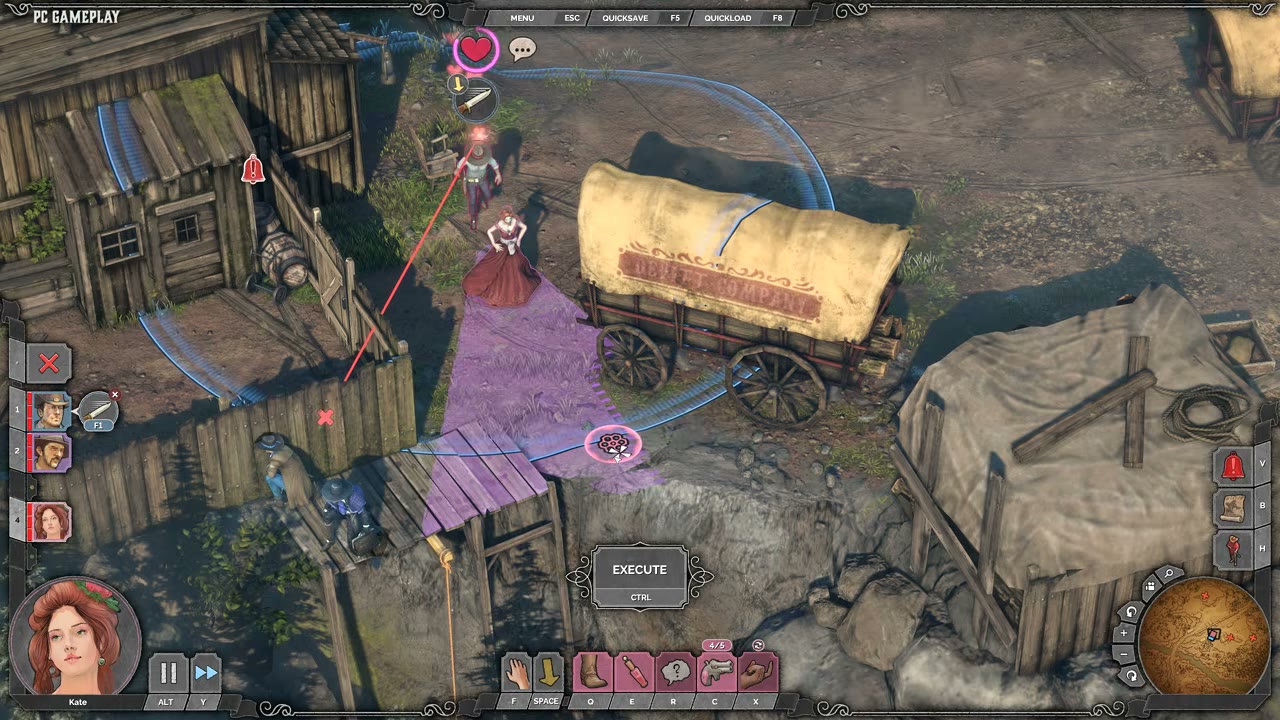
- Abilities may be executed in real time or assigned as queued actions while Showdown Mode is active.
- Ability validity is constrained by the selected character's position, movement state, line of sight, range, target type, enemy awareness, and resource count.
- Character traits include movement/mobility, health, takedown speed, weapon profile, body-handling capacity, and access to special interactions such as lockpicking, disguise use, healing, traps, lures, or mind-control style effects.
- No single character is intended to solve every tactical situation; missions require swapping roles or combining complementary kits.
- Loud weapons and noisy tools expose a noise radius or hearing risk and can trigger investigation or alarms if enemies are within range.
- Silent, disguised, accidental, or distraction-based abilities reduce detection risk but usually carry tighter positional, target, or setup constraints.
- Some abilities consume finite ammunition, charges, or cooldown-like resources and must visibly update their availability after use.
- Enemy archetypes can override or resist parts of the ability system, such as targets that cannot be handled by weaker takedowns, distractions, disguise safety, or body-control options.
- Body handling is character-dependent: some characters can move bodies poorly or not tie them, while heavier specialists can carry more or weaponize bodies.
- Mission scripting may temporarily add, remove, teach, or restrict squad members and abilities without changing the global rule that the selected character determines the active toolset.
8. BDD Scenarios
Scenario: Switching character changes available tools
- Given
- a mission has multiple controllable squad members
- When
- the player selects a different squad member from the roster or hotkey
- Then
- the selected portrait changes to that character
- And
- the action bar updates to that character's available abilities, weapons, resources, and hotkeys
Scenario: Execute a character-specific ability in real time
- Given
- the selected character has an available ability
- When
- the player confirms the ability in live gameplay
- Then
- the character performs the ability
- And
- the target satisfies that ability's range, line-of-sight, resource, and enemy-type requirements
- And
- any resource counter, noise feedback, body state, target state, or detection response updates according to the ability profile
Scenario: Queue complementary abilities in Showdown
- Given
- Showdown Mode is active
- When
- the player assigns valid actions from different character loadouts
- Then
- each queued action remains associated with its owning character
- And
- multiple squad members are available
- And
- pressing Execute resolves the planned actions as a synchronized squad sequence
Scenario: Ability blocked by character or target constraints
- Given
- the selected character has an ability highlighted
- When
- the player targets an enemy, object, or location that violates the ability's constraints
- Then
- the ability is not committed
- And
- the UI communicates invalid targeting or unavailable state without spending resources
Scenario: Use role synergy to create a safe takedown window
- Given
- an enemy is protected by vision cones or patrol timing
- When
- the player uses one character's distraction, lure, disguise, or control ability to reposition or distract the target
- Then
- the encounter resolves without alarm if vision, noise, timing, and body visibility constraints are satisfied
- And
- another character performs the takedown or body-control action
9. Edge Cases
- Selected character becomes unavailable while an ability is selected; clear the active action and refresh selection to a valid squad member.
- Ability is queued in Showdown, but the target moves, dies, becomes invalid, or leaves line of sight before execution; cancel, fail, or revalidate cleanly without stale markers.
- Resource counter reaches zero; preserve the slot but disable use and prevent further spending.
- Multiple character abilities target the same enemy simultaneously; resolve ordering, overkill, body state, and alarm reactions consistently.
- A loud weapon or tool is valid mechanically but would be heard by nearby enemies; show the risk and trigger investigation/alarm according to hearing rules.
- A body-handling action is attempted by a character with insufficient capacity or no tie/carry capability; block the command or use that character's weaker allowed behavior.
- Enemy archetype resists the selected ability; communicate why the expected takedown, distraction, disguise, or control effect does not apply.
- Mission scripting removes or swaps party members; action bars, hotkeys, queued actions, and roster states must update without retaining unavailable abilities.
- Character-specific movement limits prevent reaching the target; do not allow the ability to imply pathing or traversal that the character cannot perform.
- Disguise, mind-control, lure, or distraction effects interact with watchers; the system must still respect enemy perception and alarm rules.
10. QA Notes
- Verify every mission party composition shows only available squad members and the selected character drives the correct action bar.
- Verify each character's unique abilities, weapons, movement traits, body-handling limits, and resource counters match their intended profile.
- Verify switching characters during live gameplay and Showdown updates portrait, action bar, targeting rules, and queued-action ownership.
- Verify invalid targets do not spend ammunition, charges, cooldowns, or consumables.
- Verify noisy abilities display/produce hearing risk and cause enemy investigation or alarms when enemies are inside the affected radius.
- Verify character-specific body handling covers carry capacity, tying ability, dragging speed, thrown bodies, and inability cases where applicable.
- Verify ability interactions with enemy archetypes such as long coats, ponchos, civilians, animals, and alerted guards.
- Verify mission scripting that teaches, grants, restricts, or removes abilities leaves no stale hotkeys or queued commands.
- Verify Showdown execution preserves per-character timing differences such as melee travel time, ranged attacks, thrown tools, and lures.
- Verify save/load restores selected character, resources, cooldown-like states, body states, and queued/planning state correctly.
11. Mechanic Dependencies
- Tactical Stealth Mission Loop (The tactical stealth mission loop is the encounter context where character abilities are selected, combined, and iterated to clear objectives.)
- Disguise and Social Infiltration (Disguise and social infiltration are specialized ability categories that change how a character can move through guarded spaces and manipulate targets.)
- Showdown Synchronized Planning (Showdown planning depends on this ability system because queued commands come from each selected character's available actions and target rules.)
- Takedown and Body Control (Takedown and body control are character-dependent capabilities within the squad ability system, including different knockout, kill, carry, tie, and disposal limits.)
- Enemy Perception and Alarm AI (Enemy perception and alarm AI gate whether an ability is safe, valid, or risky through vision, hearing, investigation, and alarm responses.)
- Lethal and Non-Lethal Combat Resource Limits (Combat resource limits define ammunition, charges, weapon noise, and lethal/non-lethal constraints for many character-specific actions.)
- Distraction and Noise Manipulation (Distraction and noise manipulation are core ability categories used by multiple squad roles to reposition enemies or create safe timing windows.)
- Movement, Terrain, and Cover Navigation (Movement, terrain, and cover navigation constrain which squad members can reach positions, stay hidden, or use mobility-dependent abilities.)
12. UI Links
- Character Roster And Selected Portrait - The character roster and selected portrait expose which squad members are available and which character currently drives the active ability loadout.
- Character Action Bar - The character action bar is the primary HUD surface for this mechanic, showing selected-character abilities, hotkeys, counters, and availability states.
- Showdown Mode Execution Interface - The Showdown execution interface uses the selected character's ability loadout to queue and execute synchronized squad actions.
- Tactical Spatial Markers - Tactical spatial markers display ability targeting feedback, vision cones, noise/range risks, interaction prompts, and queued-action markers needed to validate ability use.
References
- 1.
Steam Community :: Guide :: In-Depth Character Guide (L36-104 of 336)
- 2.
Steam Community :: Guide :: In-Depth Character Guide (L143-192 of 336)
- 3.
Steam Community :: Guide :: In-Depth Character Guide (L199-250 of 336)
- 4.
Steam Community :: Guide :: In-Depth Character Guide (L251-305 of 336)
- 5.
Steam Community :: Guide :: Character guides and tricks. (L70-167 of 167)
- 6.
DESPERADOS III - Know THESE Important Tips Before Playing (1:09-3:08)
- 7.
DESPERADOS III - Know THESE Important Tips Before Playing (5:44-6:29)
- 8.
DESPERADOS III - Know THESE Important Tips Before Playing (7:52-8:50)
- 9.
DESPERADOS III - Know THESE Important Tips Before Playing (2:24-2:27)
- 10.
DESPERADOS III - Know THESE Important Tips Before Playing (5:59-6:02)
- 11.
DESPERADOS III - Know THESE Important Tips Before Playing (8:04-8:07)