
Ranged Elimination Abilities
Advanced
Shadow Tactics: Blades of the Shogun
- Status
- Released
- Year
- 2016
- Genre
- Indie, Strategy
- Platforms
- Windows, macOS, Linux
1. Summary
Ranged elimination abilities let the player neutralize enemies from outside melee reach, trading safety and positioning power against visibility, noise, ammunition, recovery, and enemy-tier constraints. The system includes reusable projectile kills, shared firearm shots, long-range scoped fire, and heavy ranged anti-Samurai fire, each with distinct line-of-sight, ammo, noise, and kill-versus-stun behavior.
3. Design Intent / Job Story
When an enemy blocks a route or patrol pattern from beyond safe melee reach, I want to select an appropriate ranged elimination option, so that I can remove or disable the target while managing noise, ammunition, line-of-sight, and enemy-type consequences.
4. Role in Gameplay Loop
- Provides a non-melee solution for isolated or hard-to-reach guards.
- Creates tactical tradeoffs between quiet reusable tools and loud limited ammunition.
- Differentiates characters through range bands, projectile behavior, ammo capacity, and target-tier effects.
- Forces planning around enemy hearing, view cones, body discovery risk, and post-shot recovery.
- Supports coordinated takedown plans when combined with distraction, stealth detection, and Shadow Mode systems.
5. Preconditions
- A controllable character with a ranged elimination ability is selected.
- The selected ability is unlocked and currently available in that character's command slots.
- The target is within the ability's valid range or effective range category.
- A clear line-of-sight or valid projectile path exists where required by the ability.
- The ability has ammunition or a recoverable projectile available.
- The player can accept the generated noise, alert, stun, or body-discovery consequences.
6. Parameters
| Parameter | Value | Type | Notes |
|---|---|---|---|
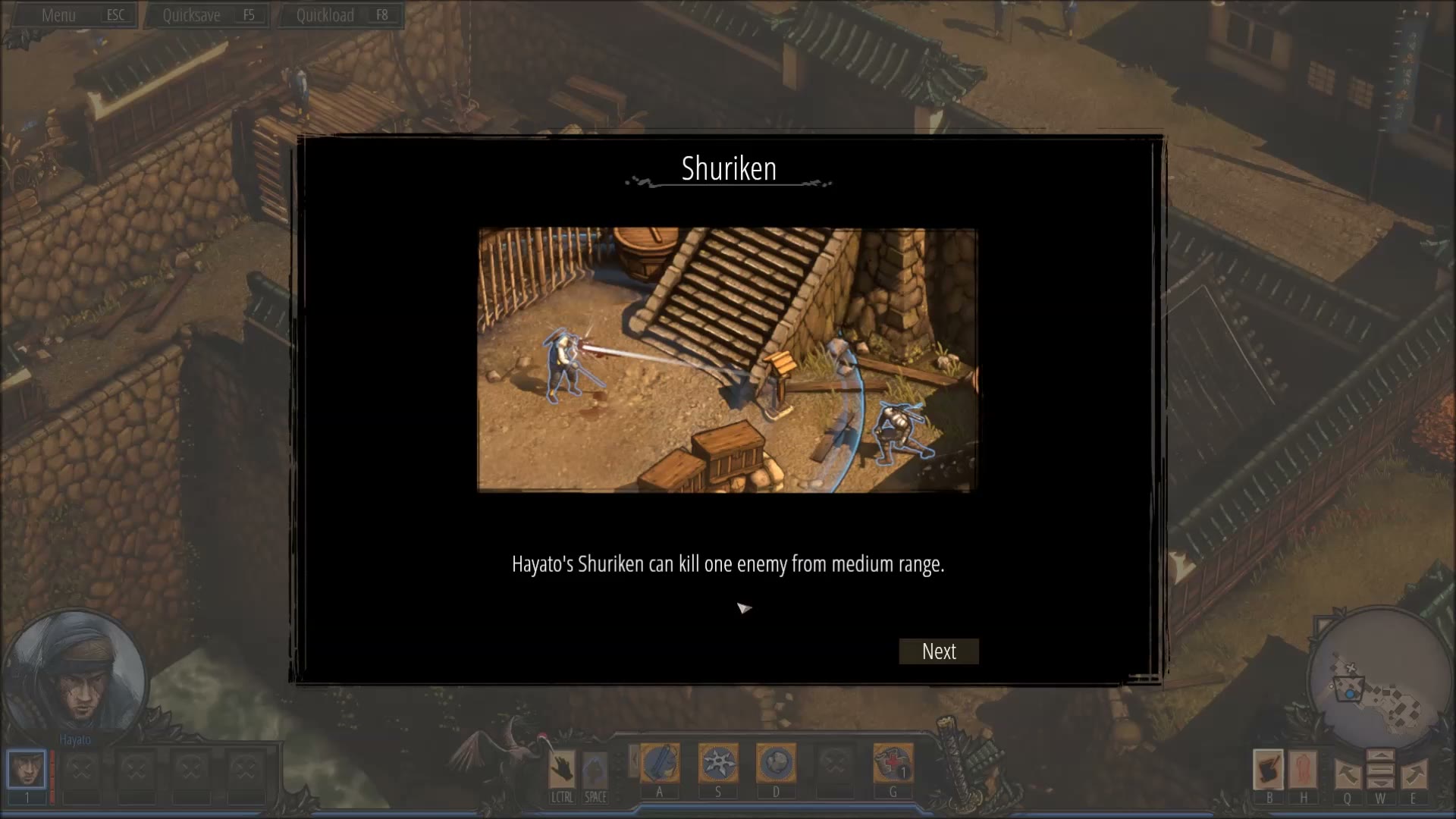
| Projectile range | Medium / limited | range band | Valid distance for reusable thrown projectile kills. Exact numeric range needs implementation or capture evidence. |
| Projectile path | Straight line / clear path | targeting rule | Projectile-style ranged kills require a valid unobstructed path to the target. |
| Projectile recovery | Required before reuse | state flag | The projectile is unavailable after use until physically recovered. |
| Victim noise radius | Visible blue circle / TBD numeric value | radius | Hearing area generated by the dying target after a projectile kill. |
| Matchlock ammo | 3 shots | integer | Standard firearm ammo pool for eligible users. |
| Matchlock reload delay | A couple seconds / TBD exact value | duration | Delay before another standard firearm shot can be fired. |
| Matchlock noise | Loud | noise level | Gunshot noise that can alert nearby enemies. |
| Matchlock Samurai effect | Stun, not kill | enemy-state result | Standard firearm effect against Samurai-tier enemies. |
| Hand cannon ammo | 2 shots | integer | Heavy ranged weapon ammo pool. |
| Hand cannon noise | Louder than matchlock | noise level | Heavy weapon noise consequence. |
| Hand cannon Samurai effect | Kill | enemy-state result | Heavy ranged weapon can kill Samurai at range. |
| Rifle range | Practically unlimited / line-of-sight gated | range band | Long-range scoped fire limited primarily by visibility and sightline. |
| Rifle noise | Silent | noise level | Scoped shot does not create firearm noise. |
| Rifle ammo | 6 bullets | integer | Scoped rifle ammunition pool. |
| Rifle Samurai effect | Stun, not kill | enemy-state result | Scoped rifle disables Samurai but does not kill them outright. |
7. Core Rules
- A ranged elimination ability may only be executed against a valid target inside its permitted range or targeting constraints.
- Abilities that require line-of-sight fail or cannot be confirmed when terrain, height, or obstacles block the path.
- Projectile-style ranged kills can create victim noise; enemies inside the visible noise radius may react even when the attack itself is not firearm-loud.
- Recoverable projectile abilities consume the projectile until it is physically recovered from the target or impact location.
- Shared matchlock pistols kill most enemies in one shot but stun Samurai instead of killing them.
- Shared matchlock pistols are loud, have three shots, and require a reload pause before another shot can be fired.
- Heavy hand-cannon fire is louder and more limited than the shared pistol but can kill Samurai at long range rather than only stunning them.
- Scoped rifle fire provides very long-range silent elimination, but still requires clear line-of-sight and limited ammunition.
- Ranged eliminations still produce a corpse or incapacitated enemy state that can be discovered unless hidden, moved, or timed safely.
- Enemy alert, alarm, and detection systems process noise, body discovery, and observed attacks after the shot resolves.
8. BDD Scenarios
Scenario: Quiet medium-range projectile kill
- Given
- a valid target is isolated within medium range
- When
- the player targets the enemy and executes the projectile ability
- Then
- the target is killed from range
- And
- the selected ranged projectile is available
- And
- the victim noise radius is shown or applied
- And
- the projectile must be recovered before the ability can be reused
Scenario: Loud firearm creates alert risk
- Given
- a firearm user has ammunition available
- When
- the player fires the weapon at a valid non-Samurai target
- Then
- the target is killed
- And
- enemies are close enough to hear a loud shot
- And
- nearby enemies can react to the gunshot noise
- And
- the firearm ammunition count is reduced
Scenario: Samurai resists standard ranged firearm lethality
- Given
- a Samurai is targeted by a standard matchlock pistol or scoped rifle shot
- When
- the player fires the ability successfully
- Then
- the Samurai is stunned rather than killed
- And
- the player must follow up with another valid elimination method before the Samurai recovers or triggers consequences
Scenario: Heavy ranged weapon kills a Samurai
- Given
- the heavy anti-Samurai ranged weapon has ammunition available
- When
- the player fires the heavy weapon at the Samurai
- Then
- the Samurai is killed at range
- And
- a Samurai is a valid target
- And
- the shot consumes one of the weapon's limited charges
- And
- the louder noise consequence is applied
Scenario: Blocked line-of-sight prevents ranged execution
- Given
- a target is outside the ability's valid path because an obstacle blocks line-of-sight
- When
- the player attempts to use a line-of-sight ranged elimination ability
- Then
- the ability cannot be executed or cannot confirm the target
- And
- no ammunition or recoverable projectile should be consumed.
9. Edge Cases
- Target enters cover, leaves range, or crosses an obstruction before the shot executes.
- Projectile impact or victim death occurs inside another enemy's hearing radius.
- A recoverable projectile lands in a dangerous or temporarily inaccessible location.
- The target is a Samurai and the selected weapon only stuns rather than kills Samurai.
- The player fires the last available shot and cannot complete a planned follow-up elimination.
- Reload or recovery timing prevents a second shot during a synchronized plan.
- A body created by the ranged elimination is visible to a patrol after the shot.
- A loud shot chains into alarm response even if the player character remains unseen.
- The player attempts to fire while the ability owner is immobilized, repositioning, carrying a body, or otherwise unable to execute commands.
10. QA Notes
- Verify each ranged ability respects its documented range category and line-of-sight constraints.
- Verify ammunition counts decrement only on successful shots and cannot go below zero.
- Verify recoverable projectile abilities remain unavailable until the projectile is recovered.
- Verify visible noise radii match enemy hearing reactions for projectile victim noise and firearm noise.
- Verify standard firearms kill normal enemies but only stun Samurai.
- Verify the heavy anti-Samurai ranged weapon kills Samurai and consumes its smaller ammo pool.
- Verify rifle shots remain silent but still obey line-of-sight and ammunition limits.
- Verify bodies or stunned enemies produced by ranged attacks can trigger detection, alarm, or follow-up requirements.
- Verify Shadow Mode timing does not bypass reload, ammo, line-of-sight, or projectile recovery constraints.
11. Mechanic Dependencies
- Stealth Detection System (Line-of-sight, view cones, noise response, body discovery, and alarm escalation determine whether a ranged elimination remains stealthy or triggers detection.)
- Character Ability System (Ranged eliminations are exposed as character abilities with character-specific slots, availability, input binding, and execution constraints.)
- Stealth Elimination Mechanics (Ranged eliminations are one branch of the broader stealth elimination system and share consequences such as corpse creation, takedown timing, and follow-up hiding needs.)
- Enemy Type Hierarchy (Enemy tier rules determine whether a ranged attack kills, stuns, or requires follow-up, especially for Samurai targets.)
- Shadow Mode Coordination System (Shadow Mode can coordinate ranged eliminations with other actions, but the ranged ability still depends on ammo, reload, sightline, and recovery constraints.)
- Four-Slot Ability Binding Framework (The four-slot binding framework determines where ranged abilities such as projectile, firearm, and scoped-shot commands appear and how players trigger them.)
12. UI Links
- Bottom Gameplay HUD Bar - The bottom gameplay HUD anchors the selected character's command set and shows availability context for ranged actions during play.
- Ability Command Bar - The ability command bar exposes ranged ability icons, slot bindings, ammo/readiness state, and selection input for projectile, firearm, and scoped-shot commands.
- Shadow Mode Command UI - Shadow Mode command UI can queue ranged eliminations as part of synchronized execution plans while still showing command targets and timing.
- Enemy Vision Cones - Enemy vision cones and line-of-sight feedback help the player judge whether using a ranged elimination will be observed or blocked.
- Detection Feedback Overlay - Detection feedback communicates the consequences of noisy shots, observed bodies, and alert escalation after ranged eliminations.
References
- 1.
Steam Community :: Guide :: Shadow Tactics: Full Character Guides and Tricks (L0-116 of 116)
- 2.
Let's Play Shadow Tactics Blades Of The Shogun - Ep. 1 - Silent Gameplay & Death! (12:49-14:06)
- 3.
Shadow Tactics: Blades of the Shogun (L6-18 of 52)